Agencies often lose trust during incidents long before they lose performance. The trigger is usually not the outage itself. It is unclear, delayed, or inconsistent communication.
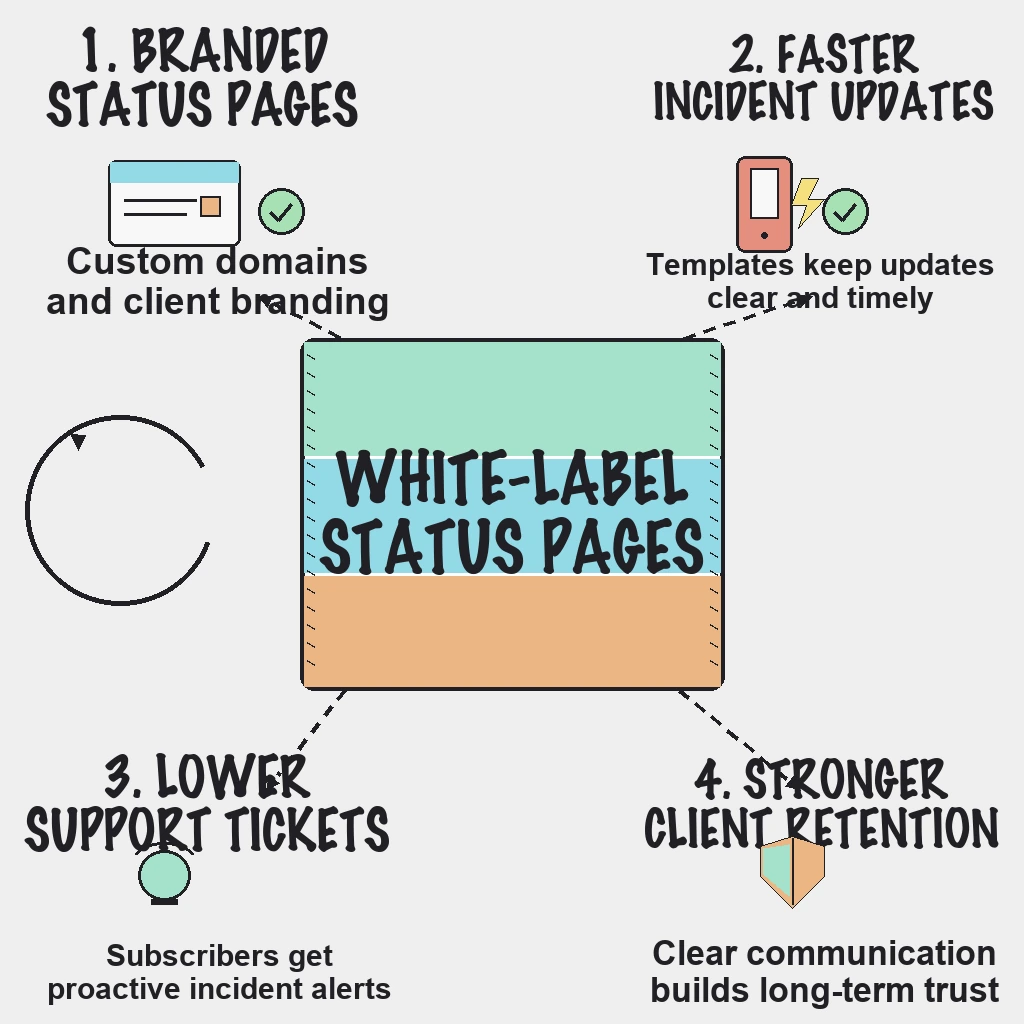
White-label status pages solve this by giving every client a branded, always-on communication surface that stays aligned with your monitoring and incident workflow.
Why This Matters for Agencies
If your team manages multiple client websites, APIs, or storefronts, incident communication becomes an account-management problem, not just an engineering task.
Without a client-facing status layer, agencies typically see:
- Support ticket spikes: Clients ask for updates in email, chat, and calls at the same time.
- Message drift: Different team members share different incident details.
- Retainer risk: Clients perceive "silence" as poor ownership, even when remediation is in progress.
- Slower recovery perception: Trust recovers slower than systems if communication quality is weak.
What a Good White-Label Status Setup Looks Like
A strong agency setup is simple and repeatable:
- One branded status page per client: Use client logo, domain, and component names they understand.
- Clear component mapping: API, checkout, dashboard, auth, and integrations mapped to business impact.
- Update cadence policy: For major incidents, post updates every 20-30 minutes even if status has not changed.
- Subscriber workflows: Let client stakeholders subscribe to incident updates directly.
- Post-incident summary standard: Root cause, fix, timeline, and prevention actions in plain language.
This removes ad-hoc comms and turns incident updates into a predictable service deliverable.
Agency Rollout Plan (30 Days)
Week 1: Baseline and Templates
- Identify each client's critical services and component labels.
- Create shared templates for "investigating," "identified," "monitoring," and "resolved."
- Define incident severity levels and the required update cadence per severity.
Week 2: Connect Monitoring to Communication
- Tie confirmed incidents to client-specific status updates.
- Ensure ownership is explicit for after-hours incident communication.
- Add escalation fallback when primary responders are unavailable.
Week 3: Train Account and Support Teams
- Train non-engineering teams on where to direct clients during incidents.
- Standardize how account managers explain impact and ETA uncertainty.
- Practice one simulation with cross-functional teams.
Week 4: Measure and Improve
Track these metrics by client:
- Time to first public update
- Update cadence adherence
- Incident communication resolution time
- Ticket volume during incidents
- Retention risk flags after major outages
Reader Questions, Answered
Do agencies really need a separate status page per client?
In most cases, yes. Separate pages improve clarity, reduce cross-client confusion, and support client-specific branding and stakeholder subscriptions.
What should we publish if we do not know the root cause yet?
Publish impact, affected components, and next update time. You can be transparent about uncertainty while still showing active ownership.
How does this reduce churn risk?
Clients tolerate incidents better when communication is fast, consistent, and easy to follow. Clear updates reduce anxiety, support pressure, and account-level trust erosion.
Wrap Up
White-label status communication is one of the highest-leverage reliability upgrades agencies can make. It turns incident updates from reactive messaging into a repeatable trust workflow.
Ready to deliver client-grade incident communication with monitoring and status pages in one place?
Related guides:
- Website monitoring for agencies
- Agency incident response playbook
- Status page best practices for customer trust
- MSP uptime monitoring playbook
- Global website uptime monitoring