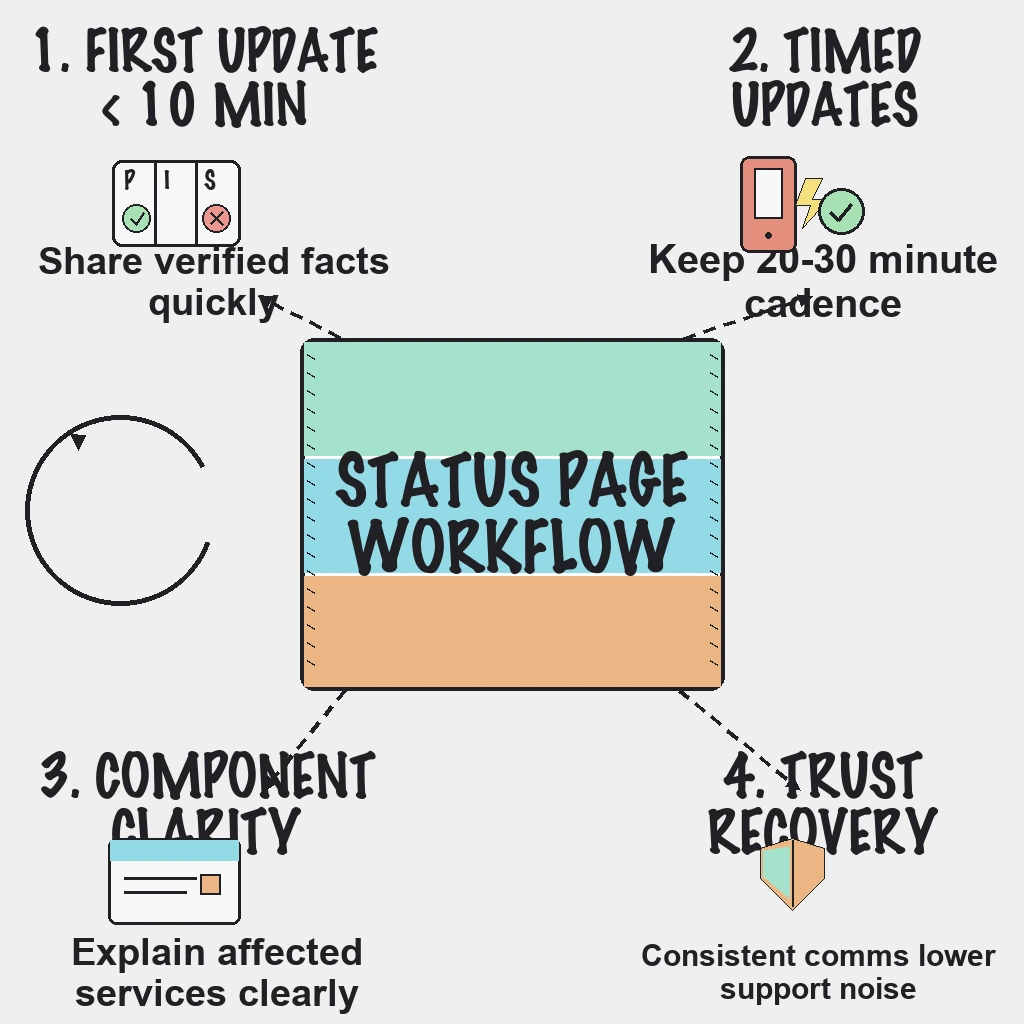
During outages, communication can either calm customers or amplify confusion. Teams that communicate quickly and predictably usually recover trust faster.
Quick Answer
Post your first status update within 10 minutes of confirmed customer impact, then keep updates on a fixed cadence until resolved.
Why Status Workflows Break
Two common failure modes:
- Waiting for perfect technical certainty before saying anything.
- Posting once, then going quiet too long.
A lightweight process with defined ownership avoids both.
Practical Workflow by Phase
Phase 1: Detection and triage
- Confirm customer impact from uptime checks.
- Set severity and affected components.
- Assign incident lead and communications owner.
Phase 2: First public update
Include:
- What users are seeing
- Which components are affected
- What team is doing now
- Exact next update time
Phase 3: Ongoing updates
- Maintain 20-30 minute cadence.
- Share progress without speculation.
- Include workaround guidance when available.
Phase 4: Resolution and follow-up
- Mark resolved after stability checks pass.
- Publish concise summary with prevention actions.
- Review whether communication SLA targets were met.
Actionable Checklist
- Define roles: incident lead, comms owner, technical owners.
- Set hard first-update SLA (for example 10 minutes).
- Standardize component naming between monitors and status page.
- Prewrite templates for investigating, identified, monitoring, and resolved.
- Review incident communication timelines monthly.
Reader Questions, Answered
How soon should the first status update be posted?
A practical target is within 10 minutes after customer impact is confirmed.
What if root cause is still unknown?
State uncertainty directly, share confirmed impact, and commit to the next update timestamp.
Should every alert be posted publicly?
No. Post publicly when customer impact is real or likely.
Wrap Up
Fast, structured status communication protects trust without slowing technical mitigation.
Ready to improve incident communication with less confusion and lower support load?
Related guides:
- Status page best practices for customer trust
- Incident management workflow for SaaS
- Incident follow-through workflow