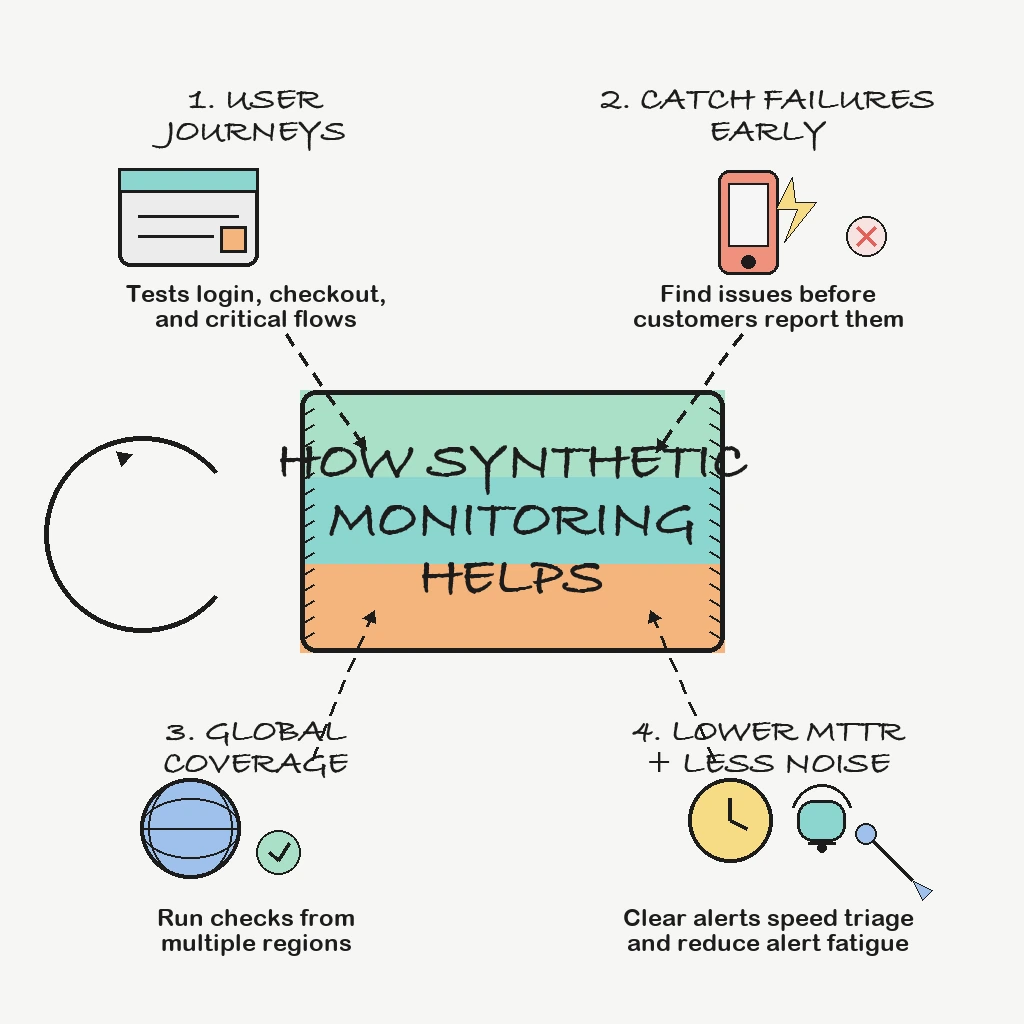
Synthetic monitoring helps by proactively simulating real user flows, such as login, checkout, and API transactions, on a fixed schedule. Instead of waiting for user complaints, teams detect failures early and resolve them before they become outages.
If uptime checks answer "Is it up?", synthetic monitoring answers "Is it actually working for users?"
Why Synthetic Monitoring Is Important
Modern systems fail in partial ways. A homepage can load while sign-in, payments, search, or downstream APIs are broken.
Synthetic monitoring is important because it validates full journeys, not just server availability.
- Finds hidden failures: Detects broken forms, failed API calls, and dependency issues that basic pings miss.
- Measures user experience: Tracks latency and step-level performance before slowdowns become support tickets.
- Improves incident response: Gives clear failure context so teams triage faster and reduce MTTR.
- Protects business outcomes: Prevents checkout failures, signup drop-offs, and other conversion-impacting issues.
How Synthetic Monitoring Helps Day to Day
Teams use synthetic checks to continuously verify the paths that matter most:
- Critical path coverage: Monitor login, checkout, onboarding, password reset, and key API workflows.
- Multi-region visibility: Run tests from several locations to catch regional degradation.
- Alert quality: Trigger notifications only when assertions fail, such as status code, text match, or response-time thresholds.
- Trend analysis: Compare latency and pass/fail history to identify recurring weak points.
Example Synthetic Check Targets
- User authentication endpoint
- Cart and checkout API sequence
- Search and filtering flow
- Billing or subscription update flow
- Third-party dependency health (payments, auth, CDN, email)
Reader Questions, Answered
What is the difference between uptime monitoring and synthetic monitoring?
Uptime monitoring checks if an endpoint responds. Synthetic monitoring validates whether complete user journeys and business transactions actually work.
Can synthetic monitoring reduce incident noise?
Yes. Assertion-based checks plus multi-region verification improve alert relevance and reduce false positives.
Is synthetic monitoring only for large teams?
No. Small teams benefit too because proactive checks prevent high-impact failures that are expensive to diagnose after users report them.
Wrap Up
Synthetic monitoring is one of the most practical ways to move from reactive firefighting to proactive reliability. It helps teams protect customer experience, revenue flows, and operational focus.
Start with two or three critical journeys, then expand coverage as your product and traffic grow.
Ready to detect issues earlier and resolve incidents faster with less noise?
Related guides:
- Why uptime monitoring helps SEO
- Global website uptime monitoring
- Status page best practices for customer trust