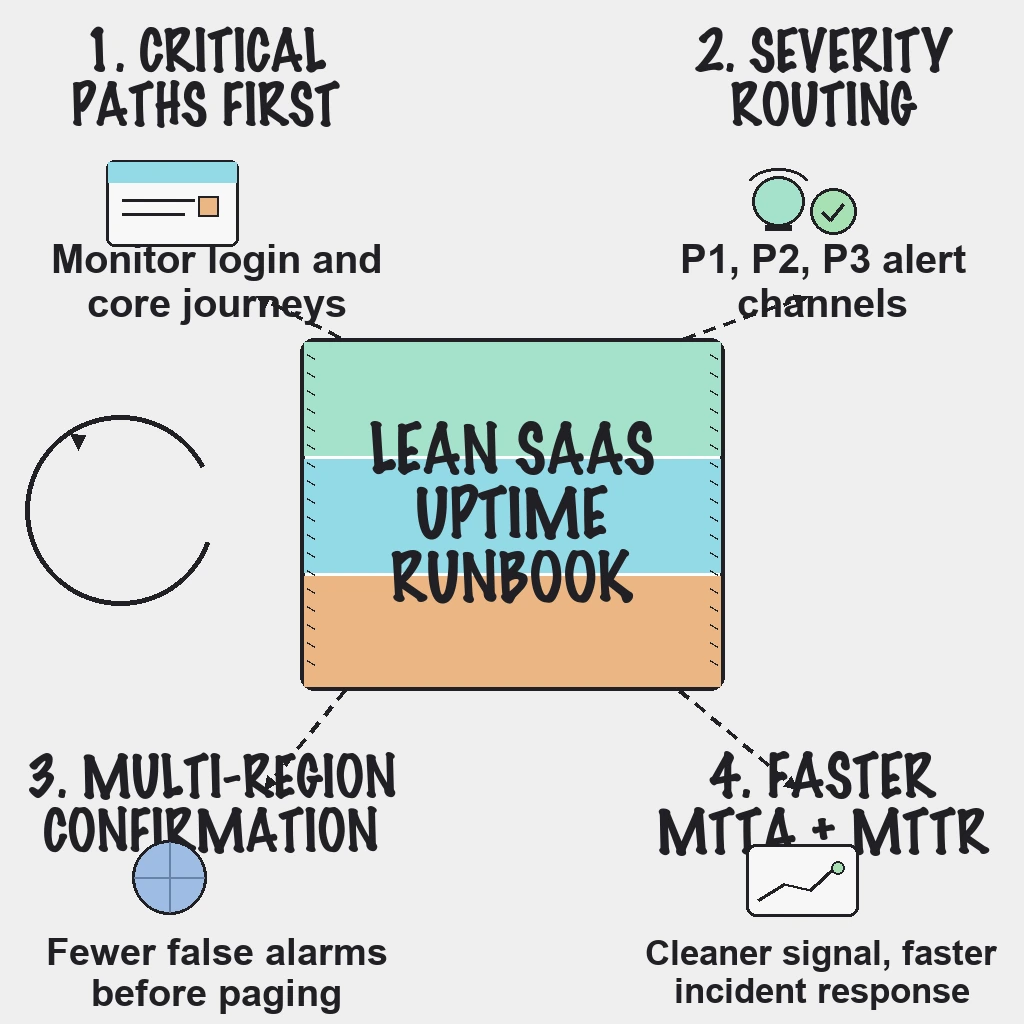
Small SaaS teams cannot triage every alert. The practical path is to monitor what customers feel first, then expand deliberately.
Quick Answer
Start with website and API checks for critical journeys, add SSL/domain monitoring, and use severity-driven notification routing.
What to Monitor First
- Homepage and login endpoint.
- Core API health and one key transaction.
- Checkout or webhook callback path.
- SSL certificate and domain expiry windows.
- Status page availability.
Alert Design That Reduces Fatigue
- P1: Customer-facing outage confirmed by at least two failed checks or regions.
- P2: Partial degradation with workaround.
- P3: Preventive warnings, such as upcoming certificate expiry.
Route P1 immediately to on-call, P2 to operations channels, and P3 to scheduled review.
Actionable Checklist
- Define 5-8 customer-impacting checks before adding deep telemetry.
- Use tighter intervals for critical flows (30-60s) and longer for secondary endpoints.
- Add retries and multi-region confirmation.
- Document escalation matrix with primary and backup responders.
- Publish status page with component states.
- Prewrite incident templates for investigating, identified, and monitoring.
- Review MTTA and MTTR monthly and retune noisy checks.
Recommended Incident Communication Flow
- Acknowledge within five minutes.
- Post first status update within ten minutes.
- Update every 20-30 minutes while active.
- Publish concise resolution summary after stabilization.
Reader Questions, Answered
What is the minimum monitoring setup for early-stage SaaS?
Uptime checks for website and API, validated alert routing, SSL/domain expiry monitoring, and a simple public status page.
How frequently should uptime checks run?
Critical customer paths usually run every 30-60 seconds; non-critical checks often run every 2-5 minutes.
How do we avoid false alarms in small teams?
Use retries, multi-region confirmation, and dependency-aware suppression to prevent single-probe noise.
Wrap Up
Lean reliability operations work best when checks are high-signal and communication is structured.
Ready to reduce alert fatigue while improving uptime confidence?
Related guides:
- Website and API uptime monitoring priorities
- How synthetic monitoring helps
- Why uptime monitoring helps SEO